Whitepaper · SMS
DLT & TRAI compliance playbook
What DLT is, who must register, the entity, header, template and consent steps, message categories, scrubbing, common rejections and what Pixabits does for you.
Pixabits team · · 15 min read
On this page
About this playbook
This is a practical summary, not legal advice. Regulatory points come from TRAI's Telecom Commercial Communications Customer Preference Regulations, 2018 (TCCCPR) as amended, listed under Sources. When the regulations and this summary differ, the regulations apply. Last checked 23 October 2026.
What DLT is
TCCCPR sets how commercial calls and SMS reach customers in India. It keeps the key records on distributed ledgers run by the telecom access providers (operators): a register of headers, a register of content templates, a register of customer preferences and a register of consent. Together these are what businesses call "DLT".
Before a commercial SMS is delivered, it is checked against those registers: is the header registered to this sender, does the text match a registered template, and does the recipient's preference or consent allow it?
Who must register
Any business or organisation that sends commercial communication, which TCCCPR defines broadly: any call or message whose main purpose is to inform about, advertise or solicit business for goods, services or an opportunity. In practice, if you send OTPs, alerts, reminders or offers by SMS from a brand name, you register as a Principal Entity (the sender).
Registration is done on an operator's DLT platform, for example Jio TrueConnect or Vi VILPOWER (see Sources). The 2025 amendment adds physical verification, biometric authentication and linking a unique mobile number when senders and telemarketers register.
Message categories
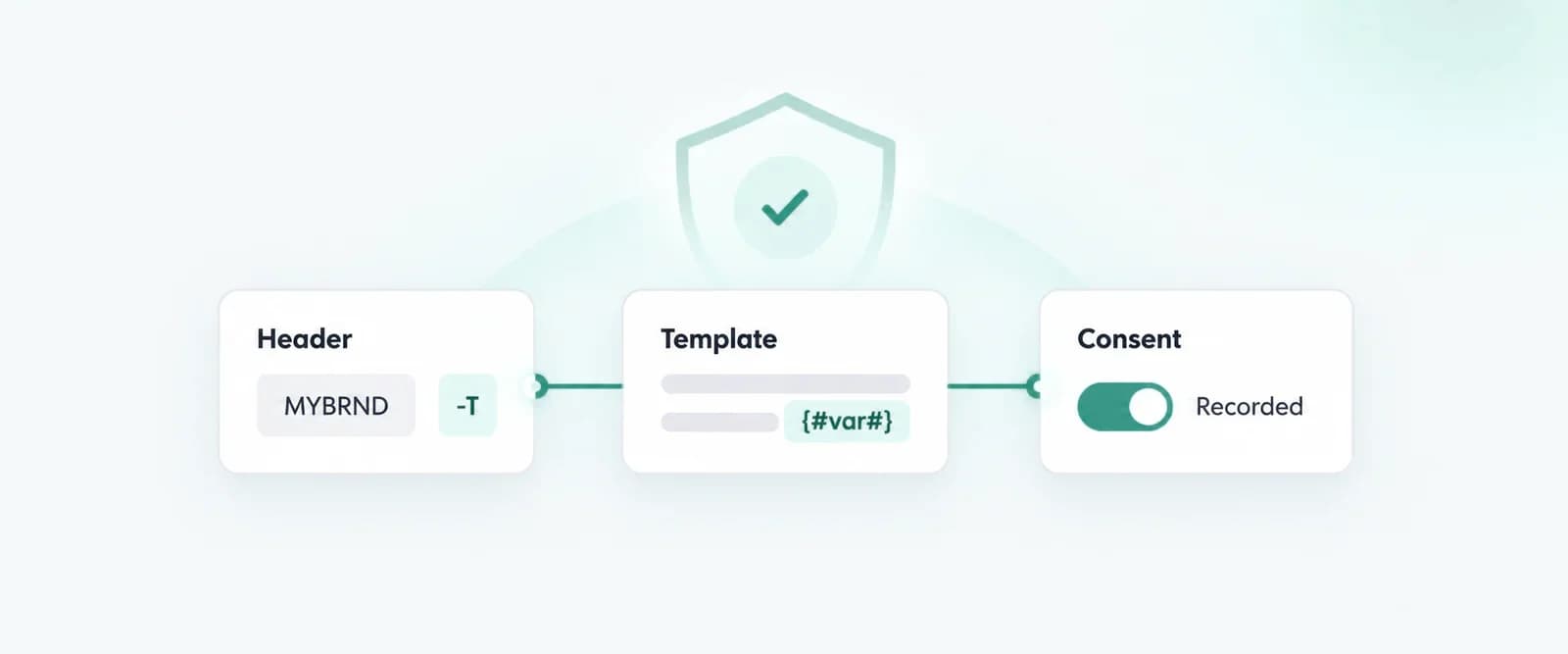
Since the 2025 amendment, a header's suffix tells the recipient what kind of message it is: -P promotional, -S service, -T transactional and -G government.
| Category | What it covers | Consent |
|---|---|---|
Transactional (-T) | Sent to your customer in response to a transaction the customer started, within 30 minutes of it: OTPs from banks and apps, transaction alerts and confirmations, balance alerts after a transaction, refund information. | No explicit consent needed. Must not be promotional. |
Service (-S) | Information to your customer about a product or service they use: warranty, recalls, software updates, safety, periodic balance alerts, delivery updates. Also messages that help complete an ongoing purchase. | Inferred consent from the relationship, valid only for the duration of the contract. Must not be promotional. |
Promotional (-P) | Promotional material or advertising for a product or service. If promotional content is mixed into a transactional or service message, the whole message counts as promotional. | Delivered only if the recipient has not blocked that category, or has given consent. Must carry an opt-out. |
Government (-G) | Sent on the directions of central or state government, a constitutional body, or TRAI, through the DLT platform. | No consent needed; cannot be blocked. |
The registration steps
Entity
Register your organisation as a Principal Entity on a DLT platform. You receive a PE ID that every header, template and message is tied to.
Headers
Register each sender ID. TCCCPR defines a header as an alphanumeric string of up to eleven characters assigned to a sender. Choose the category for each, which sets its suffix.
Content templates
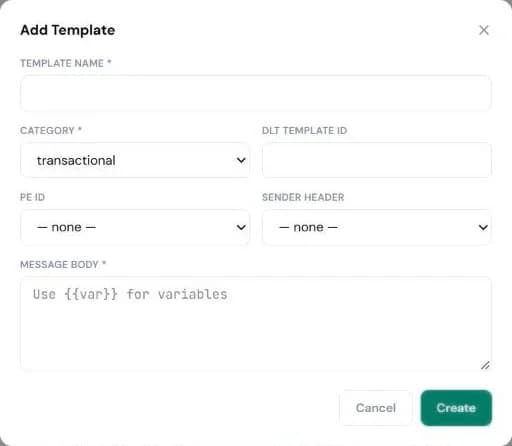
Register each message as a template: the fixed text plus marked variable parts (such as a name, amount or date). Each template gets a unique ID and is linked to a header. Since the 2025 amendment, one template cannot be linked to more than one header.
Consent
For promotional messages to customers who have blocked them, record explicit consent through the operator's digital consent process. Explicit consent must be verified directly with the recipient and recorded by the Consent Registrar.
URLs, APKs and call-back numbers
Messages that contain links, APKs, OTT links or call-back numbers are scrubbed against data you whitelist, with an undertaking that the links are not malicious.
Consent rules to know
- Inferred consent comes from the customer's conduct or relationship with you and ends with the contract. After that, service messages need explicit consent.
- Consent given to complete an ongoing transaction is valid for 7 days only.
- If a customer opts out, you must not ask for consent again for 90 days. The customer can opt back in at any time.
- Promotional messages must give an opt-out in the same message.
Scrubbing
Scrubbing is how the operator decides whether each message can go out. Under TCCCPR it compares the numbers you are sending to against the preference and consent registers, and the message against your registered header and template. Content with URLs, APKs, OTT links or call-back numbers is also checked against your whitelisted data.
A message fails scrubbing when, for example, the header is not yours, the text does not match the template, the category is wrong for the content, or the recipient has blocked that category without giving consent.
Common rejections and fixes
| Problem | Why it fails | Fix |
|---|---|---|
| Text differs from the template | Only the variable parts may change; the fixed text must match. | Copy the approved template text exactly; change only the variables. |
| Offer added to an OTP or alert | Mixed promotional content makes the whole message promotional. | Send offers separately from a promotional header and template. |
| Wrong header for the category | Each header is registered for one category. | Use a header registered for the message's category. |
| Link not whitelisted | URLs, APKs and call-back numbers are scrubbed against your whitelist. | Whitelist the domain or number on the DLT platform first. |
| Template linked to two headers | Not allowed since the 2025 amendment. | Register the template separately for each header. |
| Promotional SMS with no opt-out | Promotional messages must carry an opt-out. | Keep the operator's opt-out text; do not remove it. |
Timelines and consequences
From the 2025 amendment (TRAI press release 11/2025):
- Customers can complain about spam within 7 days of receiving it (previously 3).
- Operators must act on complaints about unregistered senders within 5 days (previously 30).
- Action is triggered at 5 complaints against a sender in 10 days (previously 10 in 7).
- First violation: outgoing services on all the sender's telecom resources are barred for 15 days. Further violations: all resources are disconnected across operators for one year and the sender is blacklisted.
- Operators may ask senders and telemarketers for a security deposit, and must sign a binding agreement with them.
For voice, the 140 number series is for promotional calls and the 1600 series for transactional and service calls. Ordinary 10-digit numbers may not be used for telemarketing.
How Pixabits helps
Pixabits does not register you on DLT; that happens on the operator's platform. Once you are registered, the console and API do this for you:
- One place for your DLT records. PE IDs, sender IDs and templates live in SMS → Assets, linked to each other. See DLT setup in the console.
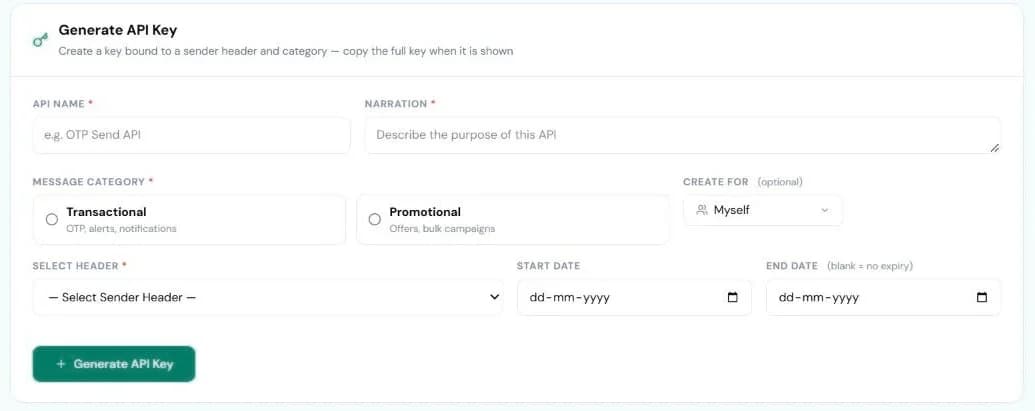
- Checks before every API send. The template must be approved and yours, the sender ID registered and active, and the template registered for that sender ID. Messages that fail are stopped before they reach the operator.
- The right DLT details on every message. The DLT template ID and PE ID are attached automatically from your stored template and header.
- Opt-outs respected. Numbers that replied STOP or UNSUB to you are always skipped by the send API.
- Optional DND filter. With
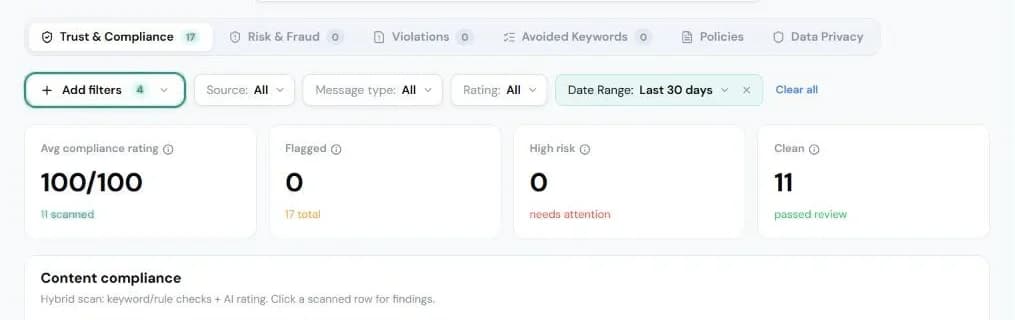
filter_dnd: true, numbers registered on DND are skipped and not charged. The check is best-effort: if the DND lookup is unavailable, the message is sent and normal operator scrubbing still applies. - Content checks. SMS → Compliance gives an advisory score for your templates and campaigns, using keyword rules and an AI rating, so you can fix risky wording before it reaches scrubbing.
Checklist
- Entity registered on a DLT platform; PE ID added in SMS → Assets.
- One header per purpose, each with the right category; added and linked to the PE ID.
- Every message registered as a template, linked to exactly one header; added with its DLT template ID.
- Promotional sends: consent recorded where needed, opt-out kept.
- Every link, APK and call-back number in your templates whitelisted.
- Offers kept out of transactional and service messages.
Sources
- TRAI: Telecom Commercial Communications Customer Preference Regulations, 2018, consolidated text up to 21 May 2026 Prepared by TRAI for reference; the gazetted text prevails.https://www.trai.gov.in/sites/default/files/2026-05/CA_21052026.pdf
- TRAI press release No. 11/2025 (12 Feb 2025): amendments to TCCCPR, 2018https://trai.gov.in/sites/default/files/2025-02/PR_No.11of2025.pdf
- Jio TrueConnect DLT platformhttps://trueconnect.jio.com
- Vi VILPOWER DLT platformhttps://www.vilpower.in